Interactive eLearning
Time Management for First-Year Teachers: Surviving (and Thriving) Your First Semester
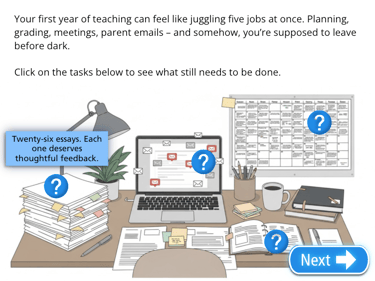
This project addresses a common challenge faced by first-year K-12 teachers: managing competing priorities with limited time. Early-career teachers often experience high cognitive load as they balance instruction, lesson/unit planning, grading, and other administrative tasks. The core issue is not a lack of effort, but difficulty prioritizing high-impact tasks and protecting focused planning time, which can lead to stress, reduced instructional quality, and burnout. This course was designed as a series of performance-focused eLearning modules, intended to support immediate, real-world decision-making.
Problem & Context
Learner
Tool(s) Used
The primary learner is a first-year teacher with:
limited classroom experience
high workload and time pressure
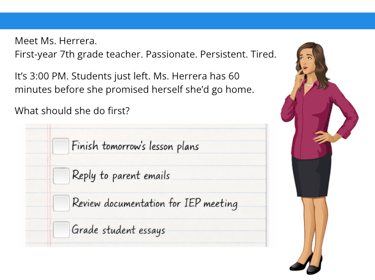
strong motivation, but inconsistent prioritization strategies
Learners are assumed to be working in fast-paced environments with frequent interruptions, requiring practical, immediately applicable strategies.
Articulate Storyline
Canva
Design Decisions
This project was designed as a ~45 minute interactive eLearning course to allow sufficient time for guided practice, reflection, and application. While the topic could be delivered as shorter microlearning, the extended format was intentionally chosen to:
support deeper skill-building, not just awareness
provide multiple opportunities for practice and feedback
The course is still structured in short, segmented sections to maintain engagement and manage cognitive load.
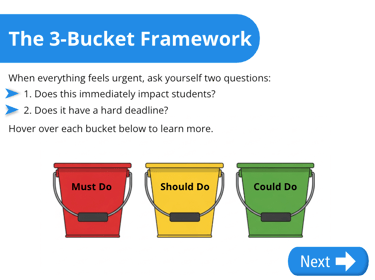
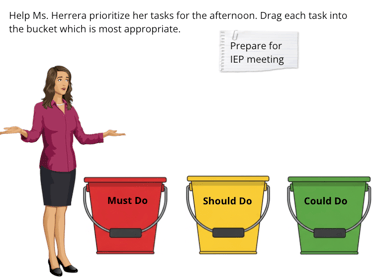
A key design decision was to incorporate guided practice using interactive elements (e.g., task sorting with immediate feedback, micro-scenario with reflection prompts). These interactions were selected to:
reinforce learning through active decision-making
provide immediate, targeted feedback to correct misconceptions
allow learners to reflect on their understanding in a safe environment
The focus is on practicing a repeatable prioritization strategy, not memorizing content.
Assessment Strategy (Application-Focused)
Assessment is embedded throughout and reinforced with a short quiz at the end. Methods include:
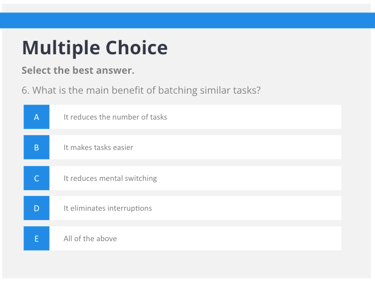
classification activities
scenario-based decision-making
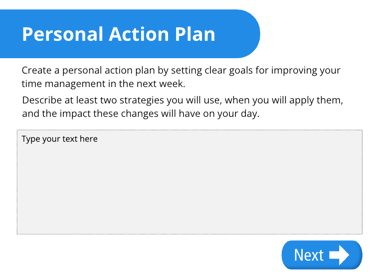
reflection prompts
This approach prioritizes application over recall, ensuring learners can transfer the skill to their daily work.
Accessibility Considerations (AODA-Aligned)
Accessibility was intentionally integrated into both visual and interaction design to support a wide range of learners. Key considerations included:
alt text on images and interactive elements
high colour contrast
legible typography (minimum 14-16pt body text)
plain language to reduce cognitive load and support comprehension
clear labels and instructions for all interactions
consistent navigation controls